


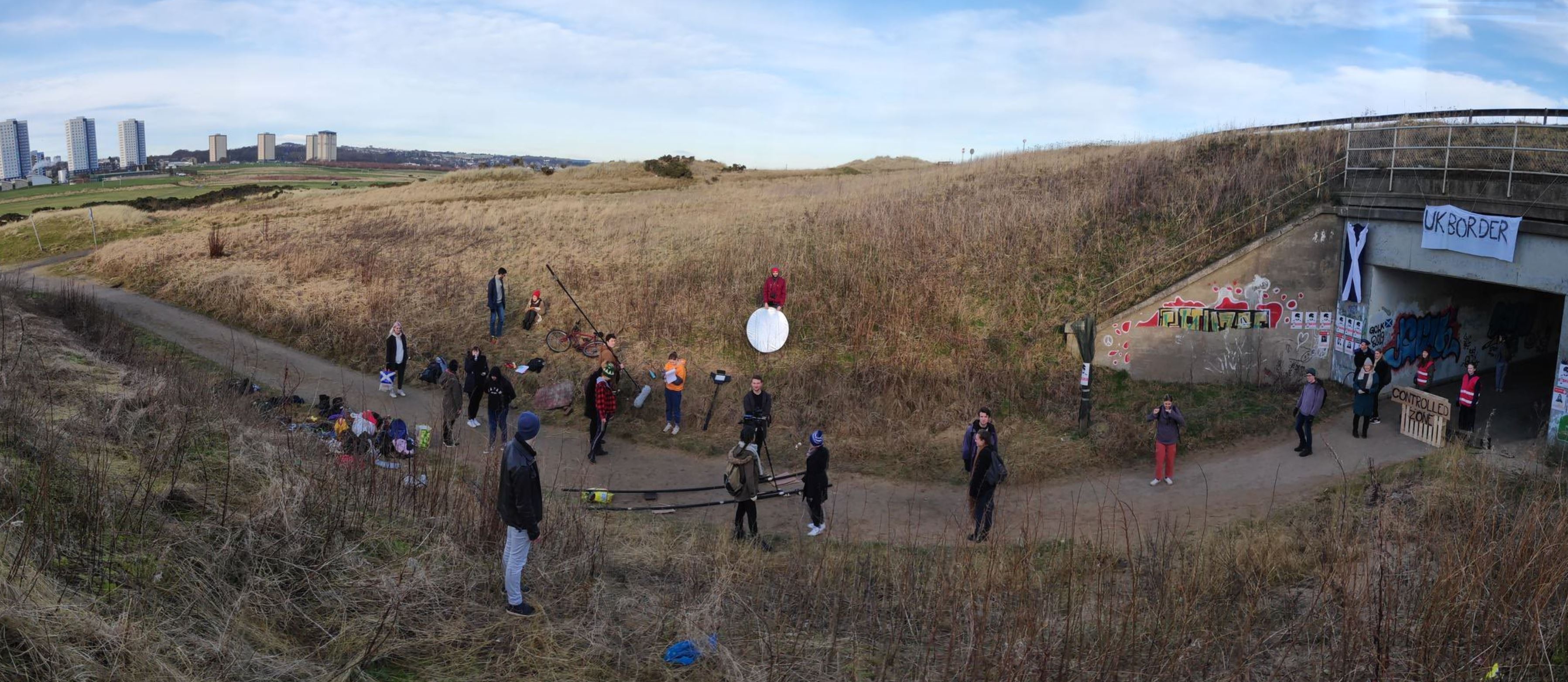
AUFS Projects tend to have a few different roles, inspired from industry standard ones but scaled down to our lack of money and skill. Here's an overview of what these roles tend to be.
It's important to remember that on very small productions, such as ours, all of these roles are extremely flexible, and are very often merged into one. For example, it's not uncommon for the director to also be director of photography and editor, or for the production sound mixer to also be sound designer and composer.
The descriptions and responsibilities of these roles is also extremely variable, and the outline below is simply an overall guideline of how it tends to be done. How you work is entirely up to you, and please don't let us dictate how to do so.
Producer
Most important non-creative role of a project. Responsibilities include
- Assembling and adminstering the necessary funds (if there's a budget), and overseeing the project as a whole.
- Working with and supporting the director (for example, preparing auditions)
- Keeping in contact with the AUFS Committee if there's any issues, concerns, or questions
- Organize the shooting schedule
- Troubleshooting problems which arise during production
- Ensuring compliance with relevant regulations, codes of practice, and health and safety laws.
- Getting into contact with the city council in order to obtain filming permits (if necessary)
- Asking potential locations (pubs, shops, etc...) about the possibility of filming there.
- Supervising the progress of the project from production through to post-production; if things start collapsing, it's up to the producer to remotivate everyone and bring the project back together.
Director
The head of the film's creative direction. At our scale, responsibilties often merge with the producer. The border between producer and director can vary a lot between projects and people, and it's not rare for the director to also produce the film - although that can be a lot (maybe too much) responsibility and work.
- Writing or working with the writers to come up with the story/screenplay.
- Envisioning the film's scope, purpose, identity, and meaning
- Supervising the location scouting process
- Auditioning and casting actors
- Ultimately responsible for any creative decisions
- Understanding and motivating actors to produce their best performance
- Holding rehearsals
- Making sure the crew is all on the same creative page, aka that the cinematography and music, for example, are contributing to a single cohesive tone.
- Directing actors and crew during shooting
- Supervising the editing and finalization of the project
- Promoting the production in festivals and other circuits
Director of Photography
As head of the camera and lighting departement, the director of photography is responsible for the technical and artistic decisions relating to the image, in accordance with the director.
- All aspects of cinematography or videography. The most important crew member after the director, and responsible for the look of the film. He or she collaborates closely with the director and production designer, and makes all decisions about camera, lighting, and equipment which contribute to what the film looks like - Is it dark and contrasty? Is it bright and low-contrast? What's the film's color palette?
- Specifying and booking the lighting and camera equipment needed
- Leader of the crew's work while the director concentrates on the actors
- Responsible for reconoitering each location in advance to assess electrical supplies and lighting design.
- The person who decides and supervises the placement of lighting instruments
- Creating a storyboard and/or shotlist with the director, based on the film's screenplay, in order to best translate the emotion and story into images
- Planning the lighting set-ups for each location
Production sound mixer/Boom operator
Responsible for actually handling the audio recording, and operating the boom pole as close as possible to the actors without it being in frame. Can be split between two people (which is often easier, as one person handles the recording, and the other handles the boom pole)
- Capturing quality, clear, clean, and consistent sound
- It is the sound recordist's responsibility to check sound equipment in advance and solve problems related to it as they arise
- The boom operator's job is to place the microphone as close to sound sources as possible without getting it in the shot or creating shadows. In a complicated dialogue scene, this requires moving the mic around to catch each new speaker
- In an interior setup, lighting and camera position are determined first, and the boom operator is expected to somehow position the mic without it being seen or causing shadows, and without losing sound quality.
- Exterior location shooting is often the most troublesome because background sound levels are uncontrollable and any hope of getting the best quality is usually compromised by a tight schedule
- Can work with the sound mixer/designer to record ADR, if necessary.
Screenwriter
The screenwriter is there to develop and translate the story into a script which will work for the screen.
- Researching the story and developping an overall narrative and structure for the film
- Writing the screenplay in accordance with the industry-standard format, this can be done in any text editor (word, google docs), although there's free software and websites which can make this process a lot faster and easier (such as Celtx, Highland 2, BetterFountain)
Production Assistant
The production assistant is repsonsible for various miscellaneous aspects of the production, and is generally just there to help out anybody who needs it. This can be helping the Sound Mixer hold the boom pole, helping the DOP set up lights, operating the clapperboard, etc... Because of the small scale we operate at, a "Production Assistant" will have more to do and it will probably be funner than being a PA would be on a "professional set" - no director at AUFS will scream at you to go and get them a red bull and some coffee (or cocaine if you're in the 70s).
Art department
Production Designer
The production designer is responsible for creating the visual appearance of the film – settings, costumes, character makeup, all taken as a unit. The production designer works closely with the director and the director of photography to achieve the look of the film.
- Designing everything in the film's environment so it effectively interprets the screenplay
- Decorating sets, overseeing the hair and makeup work, etc...
- Overseeing props and costumes, as well as designing all aspects of sets and locations
- Researching the theme and its social customs to ensure that costumes and decor are accurate and impactful.
- Facilitating the director's creative vision for all the locations and sets that eventually give the film its unique visual identity and collaborates with the art crew to find a solution for it
Hair and make-up artist
Under the responsibility of the director and production designer; this role is very often merged with it.
- Responsible for the appropriate physical appearance in face and hair, often needing careful attention to period details.
- Designing the hair and make-up of the various characters, along with the production designer.
- Being on set everyday, to prepare the actors' hair and makeup for the scenes being shot.
- A hidden part of the job is catering to actors’ insecurities by helping them believe in the way they look. Where the character demands negative traits, the make-up artist may have to work against an actor’s resistance.
Editorial
Editor
The editor is responsible for selecting the shots and assembling them in a way which best conveys the emotion and story intended by the director.
- Reviewing the storyboard with the director and cinematographer to make sure that it is editable + eventually offers ideas how to improve it to make it more smooth.
- Being on set to collect footage at the end of the day, and making sure it's all correctly backed up and organized (this may be seperated to the role of "DIT")
- Editing the film: selecting and assembling takes to best convey the emotion and story of the film, shape the actor's performance, and ultimately "re-write" the film - editing is the last step where the story can be molded and reshaped, but it is an extremely powerful one. Small changes can have a big impact on the audience's relationship and understanding of the film
Colorist
The colorist processes the footage once it has all been edited in order to transform the colors from the RAW footage into those most appropriate for the film's mood and tone, in collaboration with the director. It is the last step of post-production.
- Color grading the footage after picture lock
- Creating a 3DLUT to be used on set and in the editing process, which will aproximate the final look
- Rendering the final cut, as a video file or as a Digital Cinema Package (if needed)
Sound mixer/designer
The sound mixer/designer is in charge of all post-production sound of the film, which means acquiring/performing Foley and editing/mixing all the sound elements which will be present in the film (dialogue, music, foley)
- Providing any required sounds that accompany screen action such as footsteps, atmosphere, or even sounds like chairs creaking, clothes moving, etc... This is called "foley", and these can be downloaded from online royalty-free sources, or recorded specifically for the film.
- Cleaning up the dialogue, and ensuring it's as clear as possible.
- Creating the auditory atmoshpere of the film, in tone with it's general creative direction.
- Mixing in the music, dialogue, and effects so that each element is audible and clear when necessary, and forms a cohesive whole.
Composer
Composing and recording music for the film
- Deciding, along with the director, when there should be music in the film, the exact points at which it should start and end, and if any on-screen moments should coincide with elements of the score (this is called Spotting)
- Composing and potentially recording original music for the film, in order to best enhance the desired emotion and story, while remaining in the same creative direction as the overall film.